


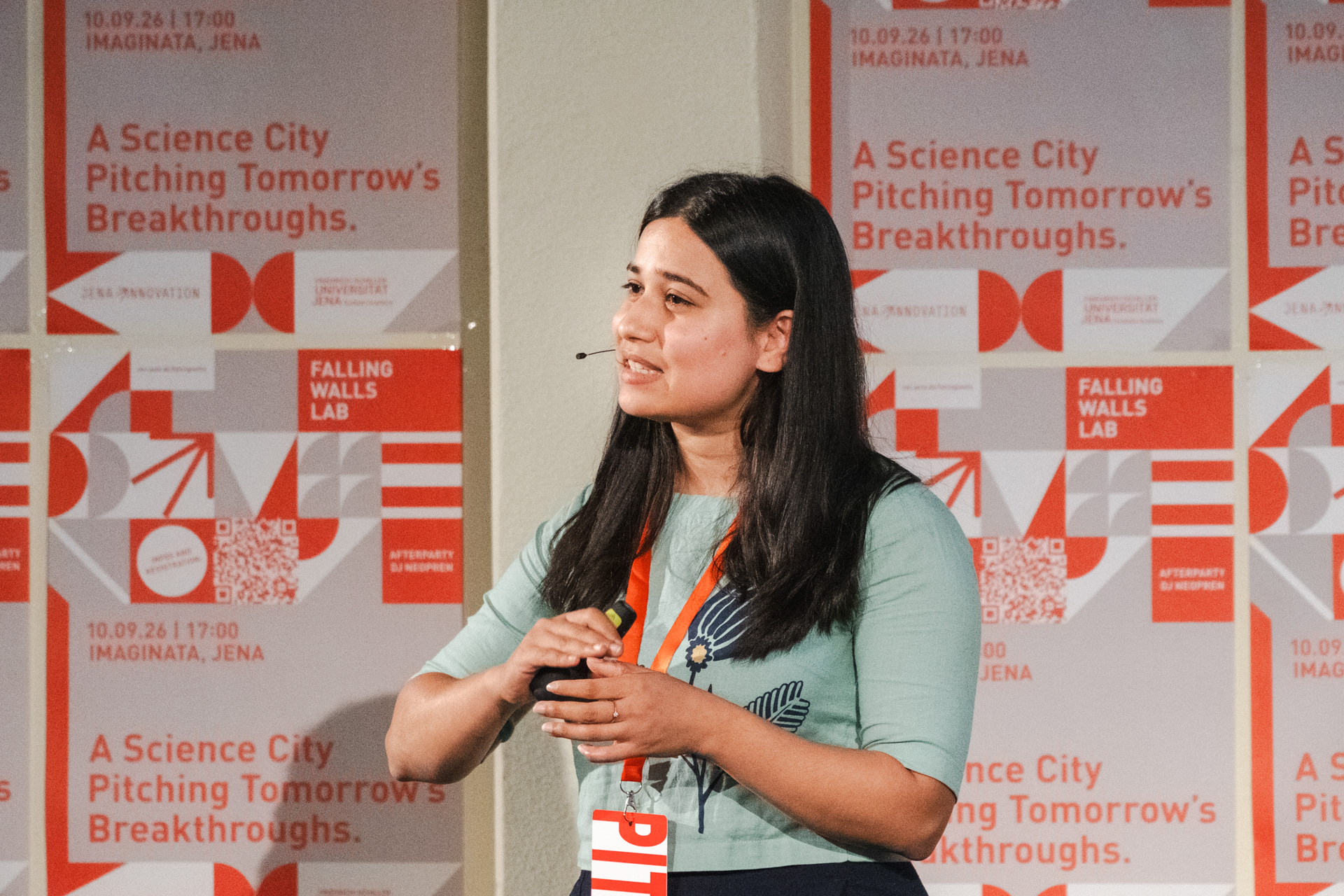
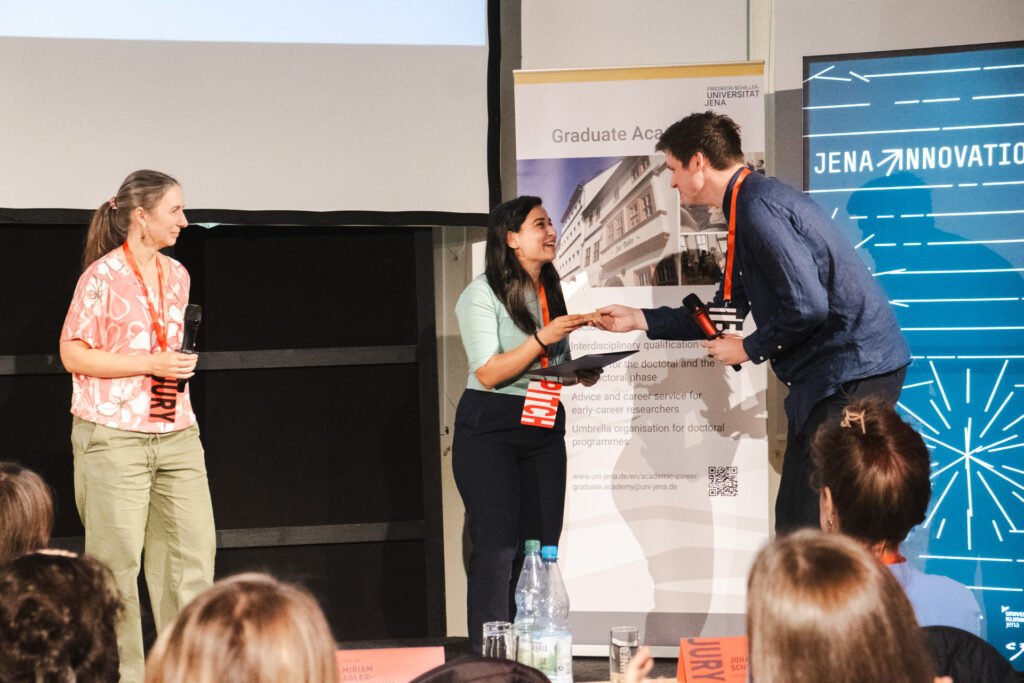
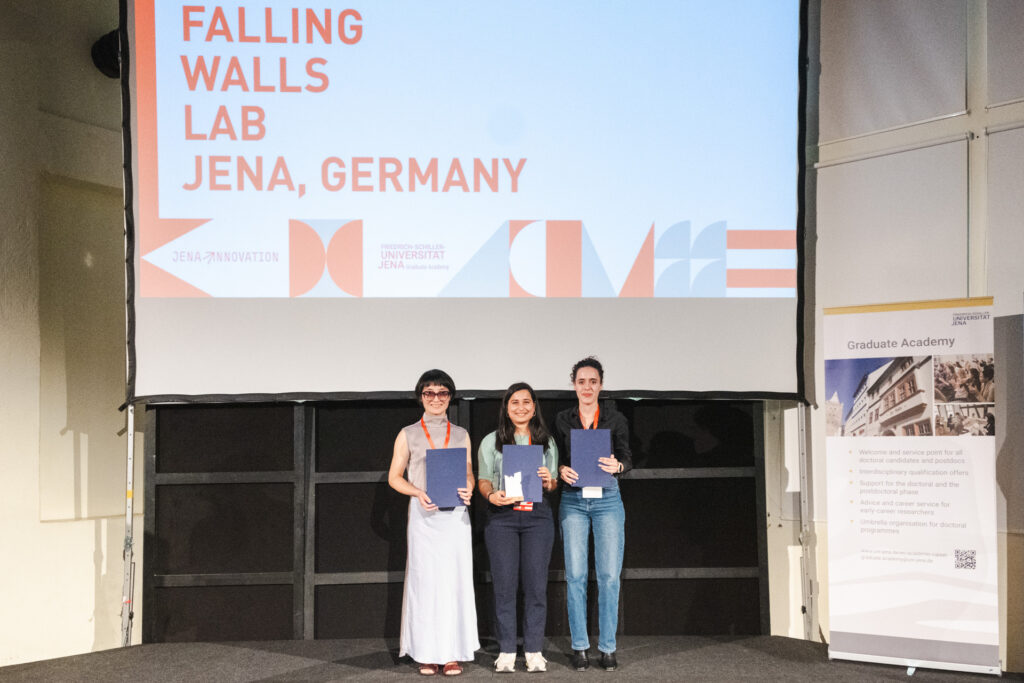
Both awards at the ‘FALLING WALLS Lab’ science competition – held in Jena for the first time – went to Dr Prerana Chaudhari, a postdoctoral researcher and project leader at the Leibniz Institute for Ageing Research – Fritz Lipmann Institute. Her pitch impressed both the expert jury and the audience. As the winner of the Jury Prize, she will now represent Jena at the international FALLING WALLS Global Final in Berlin.
In her presentation, ‘Breaking the Wall of How We Treat Broken Walls of Our Body’, the Indian-born researcher took the competition’s motto literally: her research project, SEAL, focuses on the body’s natural protective barriers – and on how these can be repaired when damaged. A well-known example of such a disruption to the barrier function is what is known as ‘leaky gut’, in which the intestinal barrier becomes more permeable.
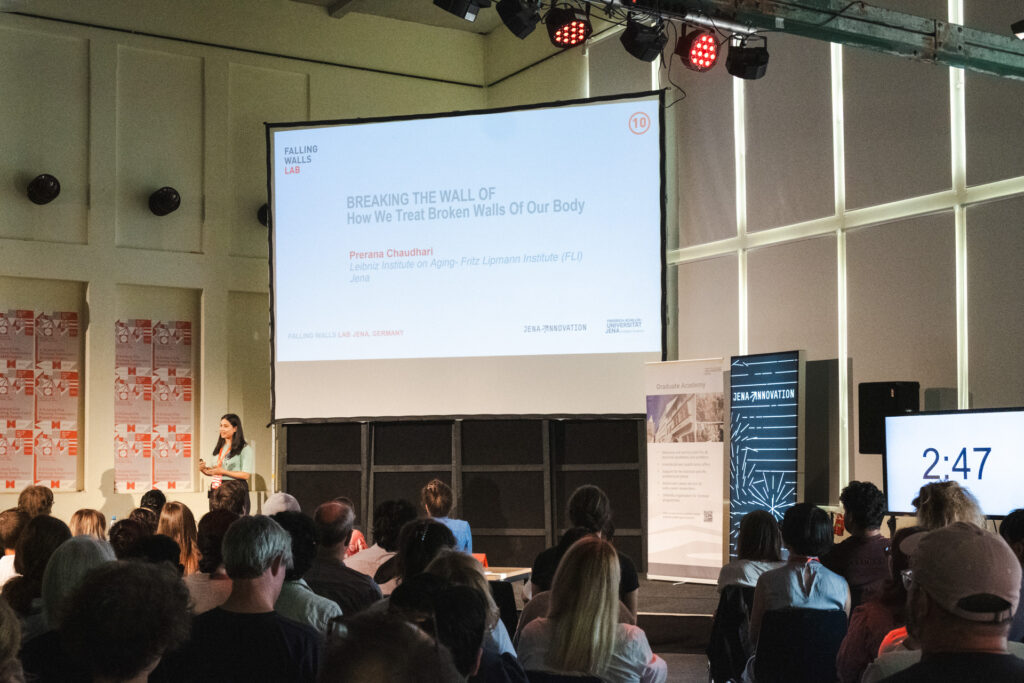
Prof. Dr Miriam Agler-Rosenbaum spoke on behalf of the jury: “Each of the eleven presentations impressed us with innovative ideas, unique perspectives and that certain spark. This made our decision all the more difficult.” However, Dr Prerana Chaudhari’s presentation surprised the jury in a special way: “She completely turned the perspective on its head and asked: Why do these walls actually stand – what makes them stable and what makes them unstable? Applied to our body’s own barriers, this means: Why do we first treat the inflammation when a barrier is damaged, instead of asking how we can restore the barrier itself? It was precisely this shift in perspective that convinced us.”
Such natural barriers play an important role in various organs of our body. If they become permeable or damaged, this can contribute to chronic inflammation and is linked to a range of metabolic, allergic, neurodegenerative and age-related diseases. To date, however, there is no approved medicine that directly restores a damaged barrier. Existing therapies primarily target the consequences, such as inflammation.
This is precisely where SEAL comes in: Chaudhari is developing novel active substances designed to directly repair damaged barriers and restore their protective function. The basis for this is a small natural molecule that emerged from research into healthy centenarians. Building on this, SEAL is developing a new therapeutic approach that not only treats the consequences of a damaged barrier but also tackles the underlying cause. In the long term, the aim is to create a platform that can be used to restore barrier function in various organs, which could open up new treatment options for a range of chronic conditions.
Chaudhari’s vision goes beyond treating damage that has already occurred. As she put it in her presentation: “Not just for treating damage, but for maintaining resilience throughout life”.
Jena sends its winner to the Global Final in Berlin
At the first FALLING WALLS Lab Jena on 10 September 2026, eleven early-career researchers and innovators from the region competed against one another at the Imaginata. The challenge: in just three minutes each, they had to convince an interdisciplinary jury which ‘wall’ their research could bring down. The decisive factors were, in particular, the groundbreaking nature of the ideas and their potential to drive scientific, technological or societal change.
The jury prize also determines who progresses to the international competition: as the winner, Chaudhari qualifies for the FALLING WALLS Global Final in Berlin, where the winners of the regional FALLING WALLS Labs from around the world will compete against one another.
A special feature of the Jena edition is the audience award. Alongside the expert jury, the audience was also able to vote for their favourite of the evening – and here too, Chaudhari was the clear choice. She thus achieved a double victory at the inaugural FALLING WALLS Lab Jena: she impressed both the jury and the audience.
With this competition, Jena became part of the international FALLING WALLS Lab network for the first time, a network that brings together up-and-coming scientific talent and their ‘breakthrough ideas’ from all over the world.
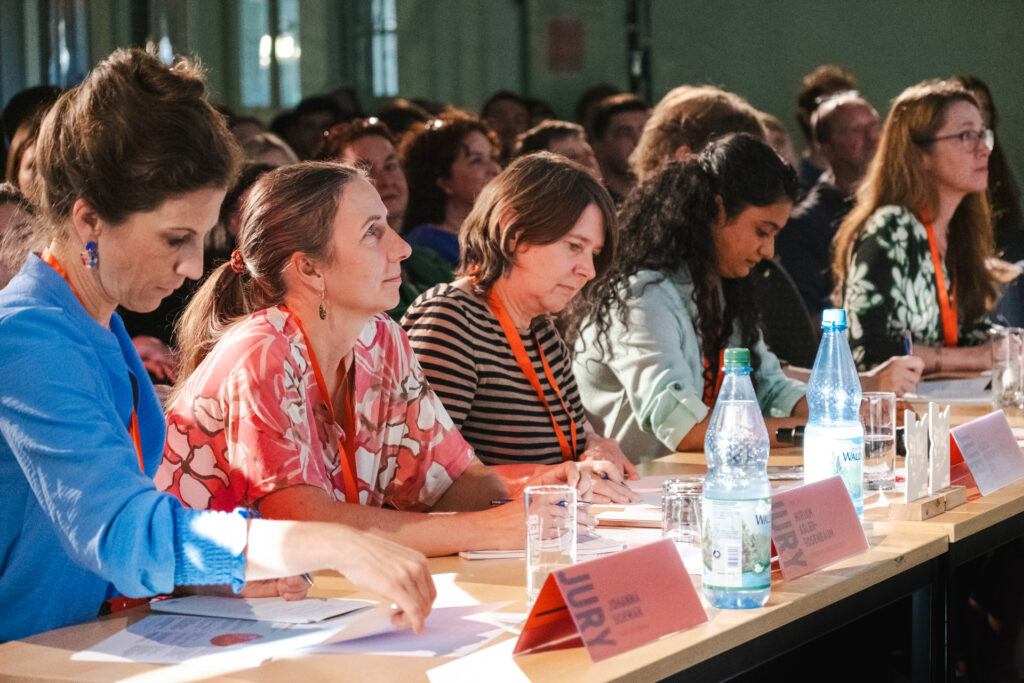
JENAINNOVATION and the Graduate Academy brought FALLING WALLS to Jena for the first time
The first FALLING WALLS Lab Jena was jointly organised by JENAINNOVATION and the Graduate Academy of Friedrich Schiller University Jena. Both organisations focus on different stages of academic career paths and are united by the aim of providing researchers with spaces in which they can further develop their ideas, showcase them and explore their potential impact.
Ede Möser, Head of JENAINNOVATION, began by paying tribute to the eleven researchers who had taken on the evening’s particular challenge: summarising years of research, ideas and academic ambition in just three minutes in front of almost 200 people is, in itself, a remarkable achievement. At the same time, he noted that the fundamental concept behind the FALLING WALLS Lab aligns perfectly with the work of the transfer initiative: “Research asks: What if? What might be possible? What do we not yet understand, and can we find out? Innovation and transfer then pose a further question: What might emerge from this?”
The point, he explained, is not that every research result must become a product or that every researcher must set up a company. Academic freedom and excellent basic research form the foundation for scientific breakthroughs and fundamentally new insights. “But sometimes research can take on a second life, beyond publication, beyond conferences and beyond the laboratory. And when this potential exists, the path to realising it should not depend on chance for researchers. That is precisely what JENAINNOVATION is for.”
As a central institution of Friedrich Schiller University Jena, the Graduate Academy supports doctoral candidates and postdocs in their academic careers and in their transition into professional life. A key element of this is the ability to communicate one’s own research in an accessible way. “Science communication is a key competence for successful researchers,” explained Judith Malsam on behalf of the Graduate Academy. “Anyone engaged in science must also be able to explain what they are researching, why this research is relevant, and ensure that it is recognised.” The FALLING WALLS Lab offers early-career researchers a platform to test precisely this very skill and to present their research in a way that is understandable to an audience outside their own field.
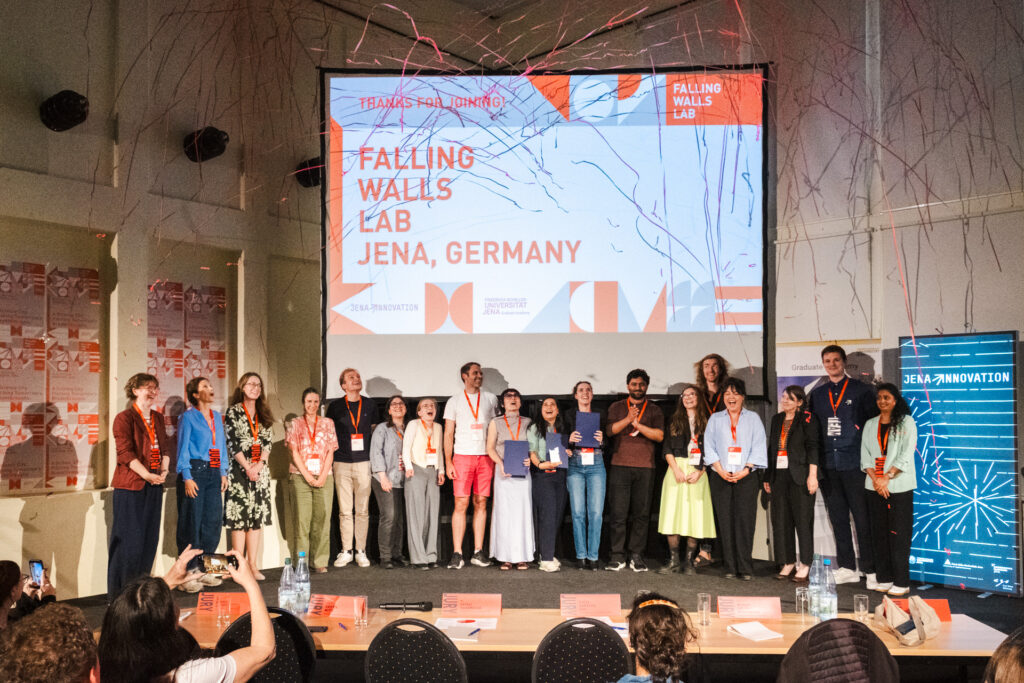
The FALLING WALLS Foundation is a non-profit organisation in Berlin, dedicated to supporting science and the humanities. It is a unique international platform for leaders from the worlds of science, business and politics, the arts, and society. Falling Walls fosters discussion on research and innovation, and promotes the latest scientific findings among a broad audience from all parts of society.
JENAINNOVATION is the overarching initiative for innovation and knowledge transfer in Jena. It supports researchers and teams in translating scientific findings into concrete applications and social impact. To this end, innovation processes are accompanied from the initial idea through to implementation and cooperation between science, industry and other social partners is strengthened. The aim is to raise Jena’s profile as a leading innovation region. JENAINNOVATION is supported by the Friedrich Schiller University Jena, the Ernst Abbe University of Applied Sciences Jena and the Jena University Hospital (JUH) and funded by the Carl Zeiss Stiftung.
The Graduate Academy is the central body at Friedrich Schiller University Jena for doctoral candidates and postdocs. It supports researchers in the early stages of their careers by providing advice, training and career development opportunities, and works to establish university-wide quality standards for the doctoral and postdoc phases. At the same time, it serves as the umbrella organisation for the university’s structured doctoral programmes. The Graduate Academy was founded in 2006.